Learning Through Play in KG
Learning Through Play: How It Builds Strong Foundations for Primary School
Quick answer:
What does "learning through play" actually mean?
Learning through play is not unstructured free time. It is a deliberate teaching approach in which teachers design activities with clear learning goals, and children explore them actively. A shop corner teaches counting and conversation. A sand tray teaches letter shapes. Building with blocks teaches measurement, balance and teamwork. The teacher observes, asks questions and gently stretches each child’s thinking.
The key difference from traditional instruction is ownership. When children choose, try, fail and try again, they are not memorizing answers — they are building understanding that lasts.
What does the research say?
Global child-development organizations are clear on this point. UNICEF states that children learn best through play, and that play creates powerful learning opportunities across intellectual, social, emotional and physical development. It also notes that quality early education generates a positive learning sequence, while a weak start widens achievement gaps later on.
This matters because the early years are a period of extraordinary brain growth. Stimulating experiences and rich interactions during these years help form the neural pathways that later learning depends on. A playful, language-rich kindergarten is not a luxury; it is the foundation on which reading, writing and mathematics are built.
Which skills does play build for primary school?
Parents are sometimes surprised by how directly play connects to academic readiness:
- Language and literacy: Role play, storytelling and songs expand vocabulary and teach children how stories are structured — the roots of reading comprehension.
- Early mathematics: Counting objects, comparing sizes, sorting and building patterns lay the groundwork for number sense.
- Focus and self-regulation: Games with rules teach children to wait, listen, follow steps and manage frustration.
- Problem-solving: Puzzles and building challenges train children to test ideas and adjust when something doesn’t work.
- Social-emotional skills: Sharing, negotiating and working in a team build the confidence to participate in a classroom.
These are exactly the skills primary teachers rely on. A child who can listen, persist and explain their thinking will progress faster in Grade 1 than a child who has only memorized letters.
How does play-based learning work at MAIS?
At MAIS, play is combined with structure and purpose. In our kindergarten, children learn through stories, songs, hands-on exploration and guided activities that build early literacy, numeracy and social skills in a warm, safe setting. English is the first language of learning, so children absorb vocabulary naturally through play, while Arabic and Islamic values are nurtured by specialist teachers.
Because MAIS is a certified Thinking School, accredited by the University of Exeter, even our youngest learners begin using simple thinking tools. A KG class might use visual Thinking Frames to sort animals, or discuss a story using questions inspired by Philosophy for Children. Kagan cooperative learning structures ensure every child takes part, not just the most confident.
How does a playful start continue into primary school?
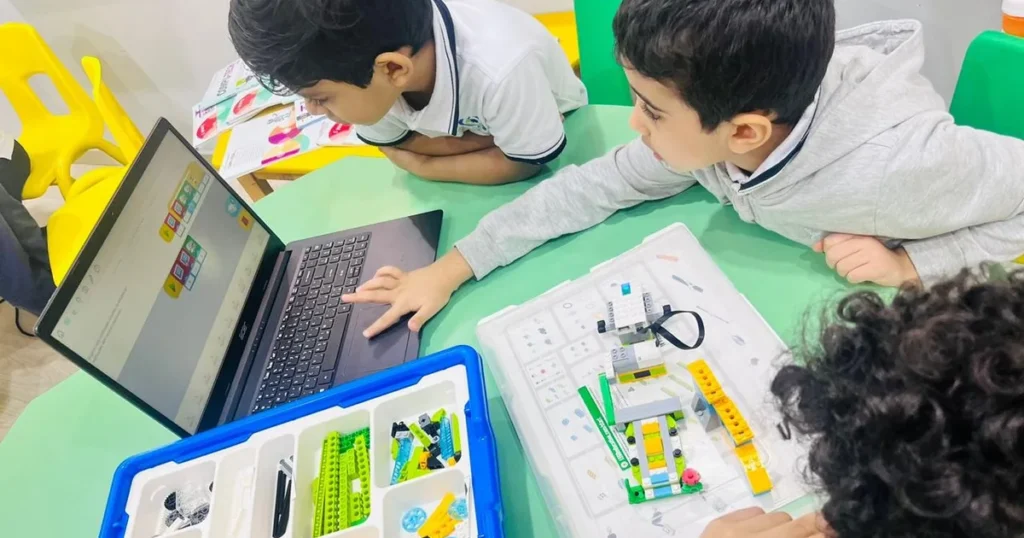
A strong transition does not mean play suddenly stops in Grade 1. In our primary years, the same spirit continues through project-based STEAM learning, robotics, experiments and augmented-reality lessons in science and math. The difference is that children now apply their curiosity to a structured American curriculum delivered through McGraw Hill ConnectED, while personal learning journals help them reflect on how they learn. The playful habits formed in KG — curiosity, persistence and collaboration — become the engine of academic success.
How can parents support learning through play at home?
You don’t need expensive toys. Try these simple ideas:
- Cook together and let your child measure, count and pour.
- Play “I spy” in Arabic and English to build vocabulary and sound awareness.
- Offer open-ended materials such as blocks, clay, paper and boxes rather than screens.
- Ask open questions: “How could we make this tower taller without it falling?”
- Read together every day and let your child retell the story in their own words.
Key takeaways
- Play is the primary way young children learn, according to UNICEF.
- Purposeful play builds language, math, focus and social skills for Grade 1.
- The best kindergartens combine play with clear learning goals.
- At MAIS, play-based KG flows into project-based primary learning.
Frequently asked questions
Is learning through play enough to prepare my child for primary school?
Will my child learn to read and write in a play-based KG?
Which private schools in Jeddah use a play-based kindergarten approach?
What curriculum does Madinati Alsageerah International School follow?
MAIS teaches English, Math and Science through the American curriculum on McGraw Hill ConnectED, alongside the Saudi national curriculum for Arabic, Islamic Studies and Social Studies.